Most agencies are discovering AI the way you discover a leak in your roof — too late, a bit panicked, suddenly patching things together and hoping for the best. Scared of the m-dash (justice for the m-dash in our opinion)
They’re layering AI tools on top of an existing structure that wasn’t built for it. Junior staff using ChatGPT to write copy faster. Reporting pulled through a new tool. A workflow that looks the same from the outside, just a little more automated under the hood.
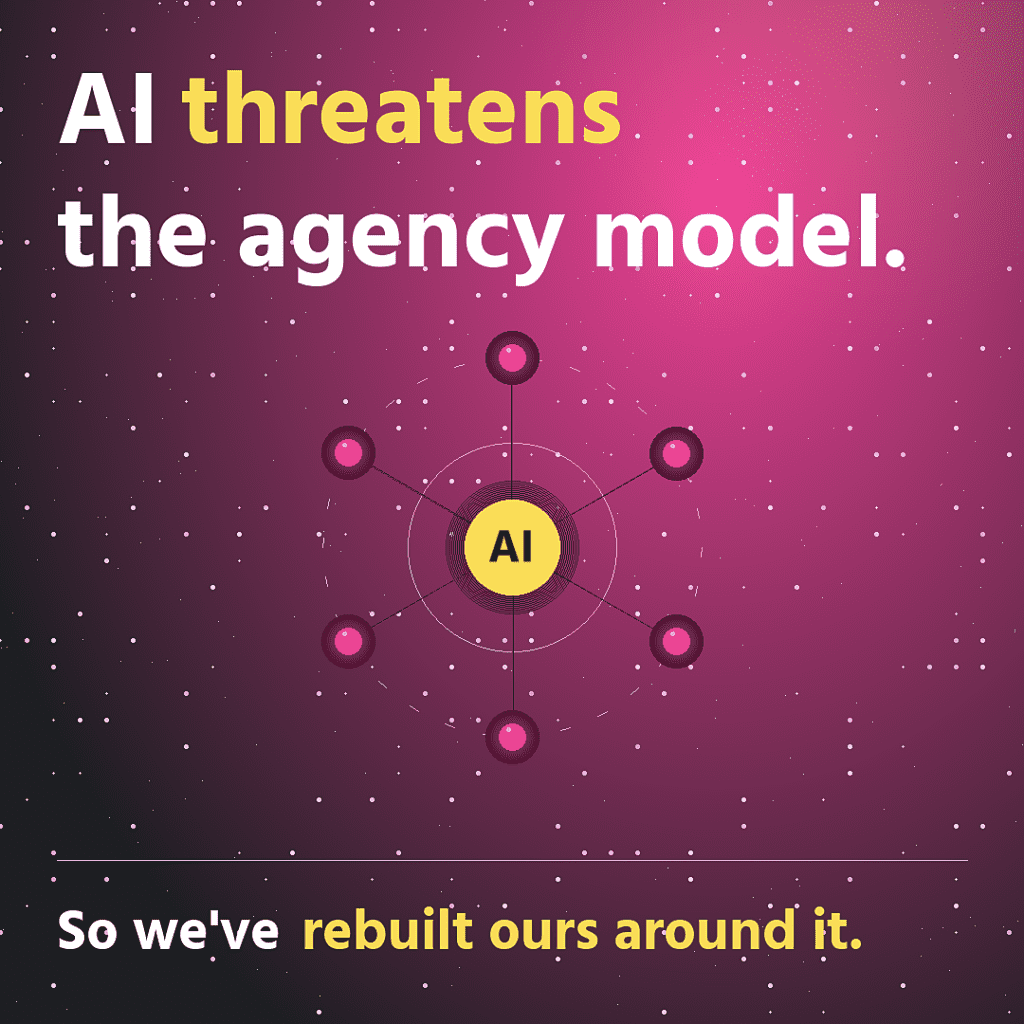
We’ve done something different. We’ve let AI dismantle the parts of our model that didn’t serve our clients, and rebuilt from there.
Hard skills at scale. Soft skills that resonate. That's the shift.
The Old Agency Model Was Upside Down
The traditional agency structure was built around volume and hierarchy for both affordability and optimal output. You needed bodies to execute. Junior copywriters. Junior analysts. Junior designers. A senior lead who – if you were lucky given time constraints – reviewed the work before it shipped.
The result? A model inevitably heavy on execution and light on strategy. And in a landscape where the marketing terrain changes every quarter – where data privacy, content velocity, and consumer attention are all moving targets – that structure has been showing cracks in the foundation.
Enter AI. Instead of perceiving it as a threat, we saw it as a correction.
What “AI First” Actually Means
It doesn’t mean AI writes your strategy. It doesn’t mean a bot is managing your campaigns. And it doesn’t mean we’ve replaced our team with a tech stack.
It means we identified every task in our workflow that required time but not judgment – and we’ve handed it to AI.
- Content at scale: More versions, faster cycles. AI drafts, humans direct.
- Reporting velocity: Instant data pulls, structured, checked insights ready before the Monday call.
- Asset variations: Test more creative, learn faster, without ballooning production costs.
The repetitive work that used to consume junior hours? AI owns it now. Which means we haven’t just gotten faster – we’ve freed up budget and bandwidth to do something more valuable.
Why “Direct-to-Client” Is the Real Differentiator
Most agencies have layers. You meet the senior team at the pitch. You work with everyone else after.
We removed those layers intentionally. Not just because clients deserve better, but because the direct-to-client model is the only one that actually works in today’s environment.
When a platform changes its algorithm, when a privacy regulation drops, when your audience starts behaving differently on a channel, you need people who can act fast, think clearly, and have the authority to make decisions. That doesn’t happen through three layers of account management.
It happens when senior talent is directly accountable to you.
Outside expertise. In-house dedication.
That’s the promise. We bring the specialist depth of an agency with the embedded care of a team that genuinely considers your business their own.
The Result: Faster Output, Deeper Thinking
As we’ve restructured around this model, the numbers have followed.
3X
Faster output
100%
Senior oversight on every account
1
Integrated team. Zero silos.
The brands we work with don’t just get campaigns. They get integrated, omni-channel work backed by measurement, attribution, and an obsession for brand building and storytelling — anchored by human judgment, multiplied by AI.
Hard Skills at Scale. Soft Skills That Resonate.
There’s a version of the AI conversation that’s entirely about efficiency. Speed, cost reduction, output volume. And yes, those things matter.
But the brands that win long-term aren’t just optimizing. They mean something to someone. They build the kind of relationship with their audience that drives repeat purchase, word of mouth, and the kind of loyalty no ad spend can manufacture.
AI gives us the hard skills at scale: the speed, the data, the asset volume. Senior humans give us the soft skills that resonate: the empathy, the storytelling, the cultural fluency to understand not just who your audience is, but what they actually care about.
Led by empathy. Rooted in social cues. Designed not only to perform, but to resonate.
If you’re a brand that wants faster output and deeper thinking, not a choice between the two, let’s talk
 Pulse
Pulse